 Reviews


 Proudly American


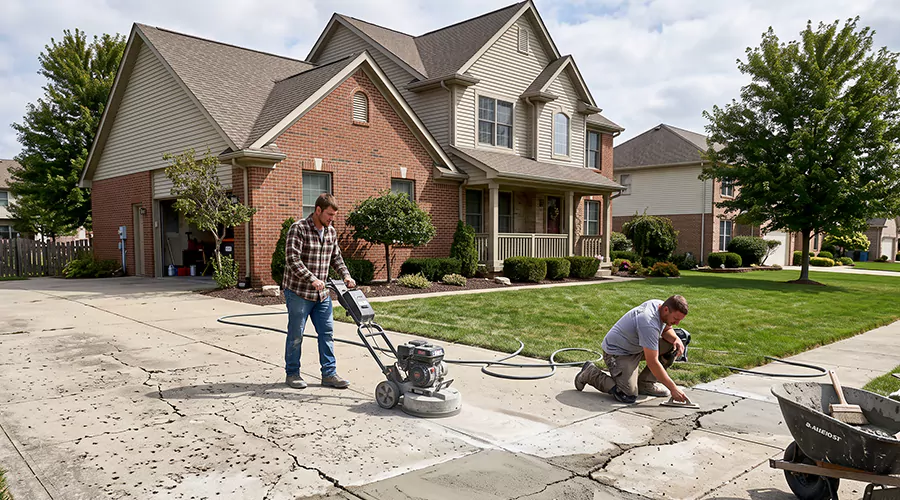
Concrete restoration is the process of repairing damaged concrete and renewing its surface so the existing slab can remain in service instead of being replaced. Fire and water restoration may be needed when fire, smoke, or water exposure has damaged concrete surfaces. It can include crack repair or patching before resurfacing. Restoration works best when the slab is still structurally stable.
It is different from simply coating old concrete. Underlying defects should be corrected first.
What Does Restoration Include?
The process can range from small repairs to full surface renewal. The right scope depends on whether damage is superficial or linked to slab movement.
Common restoration work includes:
- Cleaning the concrete
- Removing loose material
- Repairing stable cracks
- Patching spalled areas
- Correcting minor surface defects
- Resurfacing worn concrete
- Applying a protective sealer when appropriate
Restoration should not be used to hide active settlement or major structural cracking.
When is Concrete a Good Candidate for Restoration?
Concrete is a good restoration candidate when the slab remains stable but the surface has become worn. Fine static cracks and scaling can often be repaired without replacing an otherwise sound slab.
Good candidates may show:
- Surface scaling
- Minor spalling
- Fine stable cracks
- Small isolated chips
- Worn patio surfaces
- Minor cosmetic unevenness
When is Replacement Better Than Restoration?
Replacement becomes more practical when damage comes from movement below the concrete. An overlay does not add meaningful structural capacity to a failing slab.
| Concrete Condition | Restore | Replace or Correct Structure |
|---|---|---|
| Surface wear | Usually | Rarely |
| Fine stable cracks | Often | Rarely |
| Light scaling | Often | Rarely |
| Isolated spalling | Often | Sometimes |
| Significant settlement | No | Often |
| Large height differences | No | Often |
| Widespread structural cracking | Usually no | Often |
| Failed base beneath slab | No | Correct base first |
Cracks wider than about 1/8 inch deserve closer evaluation.
How Does the Restoration Process Work?
The process begins with surface preparation because repair material needs a sound base. Dirt or weak concrete can prevent proper bonding.
A typical sequence is:
- Inspect the slab for movement.
- Identify stable and active cracks.
- Remove loose or weak concrete.
- Clean the prepared surface.
- Repair suitable cracks and damaged areas.
- Apply resurfacing material where needed.
- Finish the surface to the intended texture.
- Allow proper curing.
- Seal the surface when the system calls for it.
Poor preparation can cause later peeling or flaking.
What is the Difference Between Repair and Resurfacing?
Repair addresses specific defects, while resurfacing renews a larger worn surface. Many projects use both methods.
Resurfacing is not a substitute for correcting:
- Ongoing settlement
- Poor drainage beneath the slab
- Large moving cracks
- Severe freeze-related breakup
- Major structural deterioration
The cause should be addressed before a new surface hides it.
How Much Does Restoration Cost?
Costs depend on repair needs. In 2026, basic patio resurfacing often costs about $3 to $5 per square foot, while full replacement averages closer to $10 per square foot.
Concrete resurfacing cost rises with decorative finishes or extensive patching.
| Work Type | Typical 2026 Planning Cost |
|---|---|
| Basic resurfacing | About $3 to $5 per sq. ft. |
| General concrete repairs | Around $4 per sq. ft. on average |
| Decorative resurfacing | About $7 to $20 per sq. ft. |
| Full replacement | Around $10 per sq. ft. on average |
Restoration is usually most economical on a stable slab.
How Long Does Restored Concrete Last?
A resurfaced surface commonly lasts about 5 to 12 years. Well-prepared systems can last 15 years or longer under favorable conditions.
Active cracks can shorten overlay life. Some resurfaced concrete benefits from resealing every two to five years.
What Warning Signs Mean Restoration May Fail?
Some conditions show that surface work alone will not solve the problem.
Watch for these warning signs:
- One side of a crack sits higher than the other.
- Cracks continue widening.
- Sections rock or move under load.
- Large areas are sinking.
- Water continually collects beside the slab.
- Previous patches keep breaking.
- Spalling extends deep into the concrete.
- The base has washed out.
- Large trip hazards have developed.
- Reinforcing steel is exposed.
These conditions should be investigated before resurfacing.
What Can You Check Yourself?
A crack and level check can help separate cosmetic damage from movement.
Then:
- Measure the widest part of each crack.
- Check whether both sides are level.
- Photograph the crack.
- Recheck it after several weeks.
- Look for new separation or height change.
A narrow level crack is a better repair candidate than one that keeps moving.
When Should You Call a Professional?
Professional assessment is appropriate when cracking suggests movement below the slab or a large area has settled.
Consider professional help when:
- Cracks are wider than about 1/8 inch.
- Vertical displacement is present.
- Several sections have settled.
- Reinforcement is exposed.
- A load-bearing element is damaged.
- Previous resurfacing has repeatedly failed.
- Drainage or base failure is suspected.
Specialized repair methods may be needed when ordinary patching cannot create a stable surface.
How Can You Protect Restored Concrete?
Restored concrete lasts longer when drainage and surface maintenance limit repeated water exposure.
Useful habits include:
- Keep drainage paths clear.
- Correct standing water near slabs.
- Clean the surface as needed.
- Seal the surface when required.
- Repair new small cracks promptly.
Conclusion
Concrete restoration repairs surface damage and extends the useful life of an existing slab when the underlying concrete remains stable. Fine cracks or scaling can often be repaired without full replacement. Settlement and major structural cracking need a different solution because resurfacing cannot stabilize a failing base. Before choosing restoration, check crack width and vertical movement to determine whether the problem is cosmetic or structural.
Frequently Asked Questions
Is restoration the same as resurfacing?
No. Resurfacing renews the surface, while restoration can also include crack repair and patching beforehand.
Can cracked concrete be restored?
Stable cracks often can be repaired. Moving cracks or vertical displacement require closer evaluation.
Is restoration cheaper than replacement?
Usually, when the slab is structurally sound. Basic resurfacing costs much less per square foot than full replacement in many 2026 projects.
Can badly settled concrete be resurfaced?
Not effectively until the settlement problem is corrected. An overlay does not stabilize a failing base.
How long does restored concrete last?
Many resurfaced surfaces last about 5 to 12 years, while favorable conditions can support longer service.
Does old concrete need to be replaced because of age?
No. Condition matters more than age when the slab remains stable and repairable.